
“We need to get on AI before we fall behind.” Sound familiar? The hype is exhausting, but the case studies appear compelling, and your competitors are definitely talking about it at networking events.
In practice, businesses are skipping straight to AI tools whilst their foundational processes are held together with email chains and unprotected memory. Then they’re surprised when the AI chatbot gives customers confident but wrong answers, or the automated workflow breaks because someone changed a spreadsheet column name.
The problem isn’t that AI doesn’t work. The problem is that most businesses are trying to solve a foundation issue with a top-floor solution. You can’t automate chaos. You can’t apply intelligence to a process that doesn’t exist in the first place.
So let’s be clear about what these three things actually are, when each one matters, and why the sequence isn’t optional.
Process Improvement: The Bit Everyone Wants to Skip
Process improvement is the unglamorous work of figuring out how things actually get done in your business, documenting it, and then making it less stupid.
It’s mapping out your customer journey from first contact to final delivery, spotting where things slow down or fall apart, and fixing those bits before you spend money on tools.
This is where most businesses immediately lose interest, because process mapping sounds boring and AI sounds exciting. But here’s the thing… If you don’t know what your current process actually is, AI won’t either. You’re just buying software and hoping.
I’ve worked with businesses where the sales process lived entirely in people’s heads. When they went on holiday, their deals just sat and waited. When they eventually leave, the business would have to reverse-engineer what they did well from call recordings and old emails. That’s not a technology problem. That’s a documentation problem. It’s also a behavioural problem but that’s another topic altogether!
The research backs this up. A recent MIT study found that 95% of generative AI projects fail to deliver value. Not because the models don’t function, but because businesses don’t have the operational readiness to use AI effectively. Of course, blame gets thrown around, but trying to layer intelligence on top of unclear workflows and messy data is an obvious recipe for disaster.
Process improvement asks basic questions: What are we actually doing? Why are we doing it this way? Where do things break? What’s the simplest fix?
For customer-facing operations (because that’s where revenue, retention and margin are actually decided), this often reveals patterns like:
- Leads sitting in an inbox for three days because no one’s sure whose job it is to respond
- Customer experience varying massively depending on which team member picks them up
- Manual data entry happening twice or more, because your systems don’t talk to each other
- Pricing decisions that require four email approvals
None of these need AI. Most don’t even need automation yet. They need someone to map the current state, identify the waste, and create a standard process that works.
The tools for this are straightforward: flowcharting, a few hours with the people doing the work, and a willingness to admit that “how we’ve always done it” might be costing you more than you think. A Miro board and radical honesty will do the job.
The output isn’t sexy. It’s documented workflows, standard operating procedures, and clarity on who does what. But it’s the foundation that makes everything else possible.
Automation: The Consistency Engine
Once you’ve got a process that works, automation is how you make sure it happens the same way every time, without requiring a human to remember seventeen steps.
Traditional automation (not AI) is rule-based. If this, then that. It’s brilliant for repetitive, high-volume tasks that follow predictable patterns.
For customer-facing operations in SMBs, this typically looks like:
Lead handling: A form gets submitted on your website. Automation adds the lead to your CRM, sends them a confirmation email, assigns it to the right salesperson based on their location or industry, and creates a follow-up reminder for three days later. No human intervention required until the actual conversation.
Appointment management: A customer books a service appointment. Automation sends them a confirmation, adds it to your calendar, sends a reminder 24 hours before, and follows up afterwards asking for feedback. This can massively reduce no-shows.
Invoice processing: A deal closes in your CRM. Automation generates the invoice, emails it to the customer, tracks whether it’s been opened, and sends a polite reminder if payment is overdue. Your finance person doesn’t touch it unless there’s an exception.
The ROI here is straightforward. You might already have all those things in place, but don’t miss the opportunity to tie systems together:
Are your team members using different CRMs, documents, spreadsheets, and so on, to manage their own work in the background? Stop that.
The average knowledge worker spends multiple hours on tasks that could be automated. For a small team, that’s not just wasted time, it’s opportunity cost. Every hour spent copying data between systems is an hour not spent talking to customers or solving actual problems.
Tools like Zapier, or even the automation features built into your CRM can handle most of this without requiring a developer. You’re connecting systems that already exist and telling them to talk to each other.
But automation has limits. It follows scripts. If your process changes, or if someone provides unexpected input, it breaks. It can’t think, it can’t adapt, and it definitely can’t handle nuance. That’s not a flaw, it just is what it is.
You need human oversight, clear error handling, and the understanding that automation amplifies whatever you’ve built, good or bad.
AI: The Intelligence Layer (That Needs the First Two to Work)
AI, specifically the Large Language Models (LLM) everyone’s talking about, adds something automation can’t: the ability to handle ambiguity, understand context, and work with unstructured data like emails or customer messages.
Where traditional automation follows a script, AI can interpret intent. It can read a customer email that says “I’m not happy with this,” understand they’re frustrated (even without the word “frustrated”), pull relevant information from your documentation, and draft a personalised response.
For customer-facing operations in 2026, some practical applications are:
Customer support: AI analyses incoming queries, categorises them by urgency and topic, pulls answers from your knowledge base, and drafts responses. The complex cases still go to humans, but the routine stuff (password resets, order status, basic product questions) gets handled instantly.
Lead qualification: AI reviews lead information, scores them based on how well they match your ideal customer profile, and even drafts personalised outreach messages based on their industry or role. This isn’t just speed, it’s consistency. Every lead gets the same quality of evaluation.
Retention (or churn prevention if you prefer the SaaS term): AI spots patterns in customer behaviour — reduced product usage, delayed payments, support ticket sentiment — that signal risk. It flags accounts before they cancel, giving your team a chance to intervene. Given that keeping customers is cheaper than finding new ones, what would a 5% reduction in churn mean for your profits?
The difference between this and automation is that AI can handle variation. It doesn’t break when a customer phrases something unexpectedly. It can summarise a 50-email thread in seconds. It can generate content, although that particular output does need some human intervention, so here I am.
And, technology is moving faster than ever. The line between automation and AI is blurring. Modern systems are increasingly agentic. They can orchestrate actions across tools, decide what step comes next, and even adapt workflows dynamically. That’s real progress.
But it doesn’t remove the dependency on clarity underneath.
If your documentation is scattered across shared drives and people’s memories, the AI has nothing reliable to reference. If your data is messy, it will generate sophisticated nonsense based on incorrect assumptions. If your process doesn’t exist, an AI agent won’t magically invent a good one — it will execute whatever pattern it can infer, good or bad.
The models are improving fast. But they still perform exponentially better inside structured, well-understood environments, which is why that’s what you should be aiming for in the short term.
I believe this is why the 95% failure rate exists.
Businesses buy AI tools expecting magic and get disappointing results, because they never did the boring work of cleaning up their operations first.
What Happens When You Skip Steps
The sequence matters. Not because of some theoretical framework, but because of how these things actually work in practice.
Skipping process improvement and going straight to automation means you automate a bad or non-existent process. Now instead of doing the wrong thing manually (where someone might catch it), you’re doing the wrong thing at scale.
Expecting AI to find and sift through your messy data: I’ve seen businesses try to deploy personalised recommendations on their website, only for it to expose fragmented and incomplete product information.
Using AI to handle work that doesn’t require intelligence, just consistency. This is expensive and introduces risk where none is needed. Avoid overkill when a simple automation rule would do the job better and cheaper.
Using AI without documented processes: The AI has nothing to work from. It hallucinates answers, creates responses based on incomplete information, and requires constant human checking. You end up with a tool that’s supposed to save time but actually creates more work.
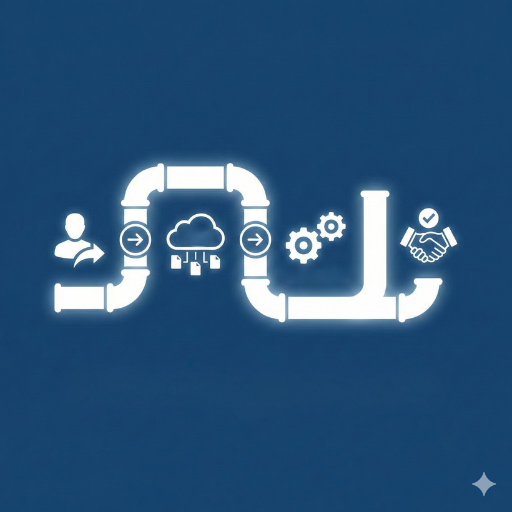
The businesses getting this right in 2026 are the ones treating it as a sequence, not a menu. They’re fixing their processes first (making sure things work), automating the repetitive bits second (making sure things happen consistently), and then layering on AI third (making sure things adapt intelligently).
None of this means you need a year-long transformation program before you experiment. In most SMBs, a few focused weeks of mapping, standardising and cleaning up the obvious friction points will put you ahead of competitors who rushed in blindly. Doing it properly isn’t slower — it’s what prevents months of expensive backtracking.
So What Do You Actually Need?
The honest answer depends entirely on where you are.
If your customer-facing operations are inconsistent, undocumented, and dependent on individual memory, you need process improvement first. Map it, standardise it, document it. It’s more about applying methodologies than tools, so the cost is low. The return is clarity.
If you’ve got solid processes but they’re manual and time-consuming (copying data between systems, sending the same emails repeatedly, tracking things in spreadsheets), you need automation. Connect your systems, let them talk to each other, and free up your team to do work that actually requires thinking.
If you’re handling high volumes of unstructured data (customer emails, support queries, sales conversations) and need to respond with decision-making at scale, then AI makes sense. But only if you’ve done the first two.
Teammate is here to help with all of the above, by the way.

AI Readiness Assessment
Is your business ready for AI, or do you need to fix your processes first? Or could you benefit from low-cost automations? Take this 2-minute assessment to find the best approach for your operations.
Question text
Your Assessment Result
Ready for Automation
Your results analysis...
The urgency here is real. AI is accelerating, your competitors are experimenting, and customer expectations are shifting. But the businesses that will actually benefit aren’t the ones chasing every new tool. They’re the ones who’ve built a foundation solid enough to support what comes next.
The question isn’t “Do we need AI?” The question is “What do we need to fix first so that when we do use AI, it actually works?”
If you’re hoping there’s a shortcut, there isn’t.