

Here’s a question for you:
If your best salesperson, your most experienced onboarding manager, and your longest-serving CS person all left tomorrow, would your customer journey still work?
Not “would it be a bit rocky for a few weeks.” Would it work?
If you hesitated, you already know the answer. Your customer journey doesn’t exist in your process documentation. It exists in people’s heads. And that’s a problem.
The Documented Version vs The Reality Version
You probably have some version of your customer journey documented. A deck. A process map. A pretty Miro board someone made during an offsite that got screenshotted and never updated.
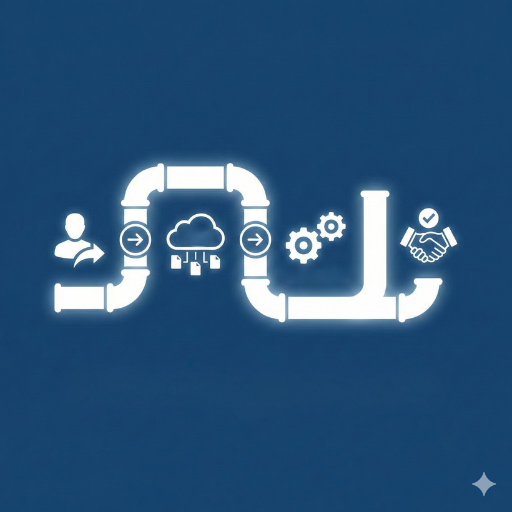
It looks clean. It makes sense. It shows exactly how a prospect moves from first touch → closed deal → onboarded customer → happy renewal.
And then there’s what actually happens.
Your website promises an experience you can’t deliver consistently.
The website talks about seamless onboarding, dedicated support, and a customer-first approach. But that experience depends entirely on which sales rep picks up the enquiry, whether the implementation team is slammed, and if the right person in CS happens to be available when issues come up.
One prospect gets a brilliant experience. Another gets a mediocre one. This happens when the system underneath can’t deliver consistently.
Sales qualification varies wildly by rep.
You have qualification criteria, right? Except one rep has a very generous interpretation of “good fit” compared to another. One digs deep into the use case and current picture. Another secures budget and authority and moves on.
So you end up with a pipeline full of prospects who’ve had completely different sales experiences, been asked different questions, and have totally different expectations about what happens next.
The sales handoff breaks.
Sales closes the deal and sends a message saying “new client, they’re keen, start date TBC.” No context on what was promised. No clarity on why they bought or what success looks like for them.
So the next team, sure enough, starts from scratch. They ask questions sales already asked, or just make assumptions. And the client’s first experience post-sale is repeating themselves and wondering if anyone’s actually talking to each other.
Critical steps only happen if someone remembers.
There’s supposed to be a check-in call on day 30. A handoff meeting between teams. A review of usage data at month three. A renewal conversation at month ten.
But these things don’t happen automatically. They happen if someone remembers, as long as the teams aren’t already too busy. If the CRM reminder doesn’t get snoozed.
But when they don’t happen, the client feels it. They feel dropped. Forgotten. And months later when they churn, you’re sitting there wondering what went wrong.
Support escalations have no clear owner.
A customer issue comes in that needs someone senior. So it gets escalated. But then it just sits, because no one’s quite sure whose job it is to pick it up. Or because your business is so free from trust that the most minor decision requires multi-level sign-off.
Meanwhile, the customer is waiting. Their perception of your business is being shaped by the fact that their urgent issue disappeared into a void.
Things work fine until they don’t.
Here’s the tell: everything ticks along nicely during quiet periods. Christmas, mid-summer, the weeks before financial year-end when budgets are frozen.
Then the busy season hits. New deals flood in. Your team’s suddenly handling twice the volume and the whole thing haemorrhages.
Qualification gets rushed. Onboarding times blow out. Support tickets pile up. CS managers are stretched so thin they’re just firefighting. Steps get skipped, handoffs break, and customers notice.
When things calm down again, everyone breathes a sigh of relief and pretends it’s fine. Except it’s not fine:
You’ve just run a mini-experiment in what happens when you try to scale, and it failed.
Twice a year, every year, your system shows you it can’t handle volume. Yet no one treats that as the warning it is.
Why This Happens
Most likely, you grew faster than your systems could keep up with.
In the early days, everyone just figured it out. People wore multiple hats, knew all the customers personally, and could fill in gaps without thinking about it.
Then you hired more people as you took on more clients. Yet the knowledge of how to do things well stayed with the people who’d been here from the start.
No one sat down and said “right, let’s document exactly how this works before we scale it.”
You just kept moving & kept growing, and kept assuming new hires would pick things up by osmosis.
Well, now you’ve got a customer journey that exists in theory, but fragments in practice. It works when the right people are involved and volumes are manageable, but breaks when they’re not.
This is tribal knowledge. The unspoken “we’ve always done it this way” that no one can quite explain. The steps that aren’t in the process doc because they’re “obvious” to people who’ve been here for years.
They’re not obvious to the person who started three months ago. And they’re definitely not obvious to the customer experiencing inconsistency and wondering if and when you’ll get your shit together.
What This Actually Costs You
Your customer experience is a lottery.
Remember that customers talk to each other. They write reviews and compare experiences. And when they realise it’s random whether they get good service, that erodes trust. Goodbye, prospects.
Your marketing and CRO efforts are wasted.
You’ve optimised your website, refined your conversion funnel, and improved your messaging. And it’s working: more qualified leads are coming through.
But if the experience post-sale doesn’t match the expectation you set pre-sale, all that work is wasted. You’re bringing people in the front door and disappointing them right from the off.
You can’t scale this.
You want to grow? Great. Can your current customer journey handle double the volume?
Not “can your team work harder.” Can the system handle it?
If any of the previous points sound all too familiar, the answer is probably no.
You’ll just break more often, with more customers watching.
Your team burns out.
Everyone’s working hard. But it’s inefficient, inconsistent, and exhausting. And eventually, the people holding all the knowledge get tired of being the single point of failure and leave.
And when they do, the whole thing is at risk of falling apart.
How To Spot This In Your Own Business
Here are the diagnostic questions:
Does the customer experience vary based on who’s involved?
If you mapped five customer journeys from first touch to renewal, how consistent would they be? Same qualification questions? Same onboarding steps? Same check-in cadence? Or does it depend heavily on which team members handled them?
What breaks when volumes spike?
Look at your busiest periods. What falls apart first? Longer response times? Skipped steps? Quality drops? If things work when you’re quiet but collapse under the pressure when you’re busy, your system isn’t ready to scale.
Ask your team: “What would break if you weren’t here for two weeks?”
If the answer is more than “my inbox would be full,” your processes aren’t documented properly. If critical steps only happen because a person remembers, those steps aren’t in your system. They’re in someone’s head.
Where do things go quiet for the customer?
Map the journey from their perspective. Where do they hear nothing for days? Where do they have to chase you? Where does the handoff between teams create a gap?
Those quiet periods point to the breaks in your system. And your customers are noticing it right now.
Can a new hire deliver the customer journey without constant help?
Give them the process documentation and see what happens. If they have to interrupt someone every 20 minutes to ask “how do I actually do this?”, your documentation is useless.
What To Do About It
Step 1: Map what actually happens. Not what’s supposed to happen.
Shadow your team. Watch how they actually do the work across the entire customer journey — from first website visit to renewal conversation. Record the questions they ask. Note the tribal knowledge. Document the workarounds.
Don’t start with the process map from 18 months ago. Start from scratch. Watch reality, then document that.
Step 2: Find the inconsistency.
Where does the experience vary based on who’s involved? What does your best performer do that others don’t? What gets skipped when volumes spike?
That’s where the leverage is. That’s what needs to be standardised, documented, or automated.
Step 3: Make it repeatable.
Take the tribal knowledge out of people’s heads and put it somewhere permanent. Process docs. Checklists. Automated handoffs. Templates.
The goal isn’t to turn people into robots. It’s to ensure the baseline experience is consistent regardless of who’s involved or how busy things are.
Step 4: Stress test it.
Don’t wait for the next busy season to find out if it works. Simulate volume. Give new documentation to your newest team member and see if they can execute without constant help. Test the handoffs. Find the weak points before customers do.
Step 5: Only then think about improving or automating.
Once you know what actually happens (and made it consistent) you can start truly improving it. Cutting wasted steps, speeding things up, and automating.
Because if you try to automate a process that only truly exists in people’s heads, you’ll just automate chaos.
This is exactly what Teammate’s Operations Performance service is designed for. We map what’s actually happening across your customer journey, identify where processes break or rely on tribal knowledge, and help you build systems that work consistently, even when volumes spike.
The bottom line: Your customer journey is only as good as your weakest handoff, your most inconsistent performer, and the things that happen “if someone remembers.”
If it exists in documentation but not in practice, you don’t have a system. You have hope, dressed up as a process.
And hope doesn’t scale. Especially not when you get busy.
Map reality first. Make it consistent. Test it. Then improve it.
And if you don’t have someone in your business dedicated to carrying out this kind of work, Teammate is here to help. We’ll figure out what’s actually happening vs what you think is happening, and fix the gaps before they cost you more customers.